The Brainstorming Method
The brainstorming method is one of the most popular ways to solve problems. It involves generating ideas as a group, typically composed of individuals who are directly connected to the …
We provide creative solutions to clients around the world,
creating things that get attention and meaningful.
At the time of writing this article, I have 15 years of experience in operational excellence in manufacturing, and for all these 15 years, I have been working on improving performance indicators. Strangely enough, wherever I worked, I heard the same reasons affecting poor performance. Obviously, if you ask a manager or operator what the main cause of problems is, the first things you hear are phrases like “Frequent breakdowns,” “Poor equipment design,” “Low-quality raw materials or packaging,” etc. And all these reasons are valid. However, if you dig deeper, it turns out that several fundamental factors, closely tied to management, affect all of the above. Here they are:
All these factors often prevent goals from being achieved, and even if they are achieved, it’s at a high cost.
Now imagine a production environment where:
I could continue describing a highly efficient workplace, but I think the main idea has been conveyed. An effective workplace is one where employees are informed about important matters and involved in the process of eliminating losses.
The Daily Management System (DMS) is a fundamental system for building a highly efficient organization and represents a regular performance management process based on short, focused, daily meetings using digital or physical boards, involving representatives from all functions and levels of the organization.
An effective meeting is one where the team:
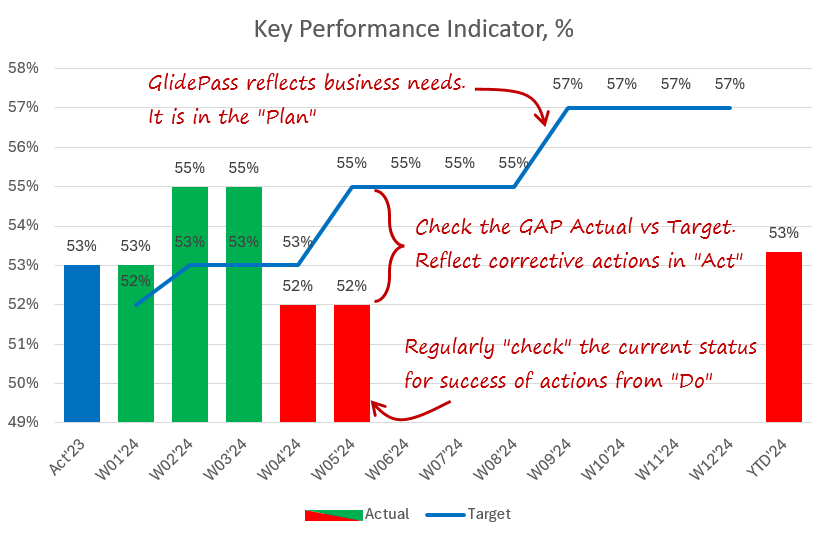
When we come to a meeting, we bring with us a lot of data. This can be performance indicators from the previous period (shift, day, week, etc.), problems that have arisen, the current status of ongoing activities, feedback from employees (escalated problems), and feedback from management (cascaded actions). The goal of the meeting is to turn this data into further actions. The outcome of the meeting can be feedback for a lower-level meeting, actions to eliminate a problem, or escalation to a higher level if the problem remains unresolved.
In other words, the meeting’s goal is to transform data into actions and answer three questions:
As mentioned earlier, DMS is based on short meetings, each held at its respective level and department. The classic structure of production DMS consists of four levels, with the first level being the operators’ meeting, the second level – the line meeting, the third level – the section meeting, and the fourth level – the factory meeting. Each meeting involves a cross-functional team of key employees relevant to that specific meeting. The structure is designed so that a representative from each lower level is present at the next level meeting.
For example, at the first level, operators meet to hand over the shift. During the shift handover, there is a review of the status of safety and quality, the performance indicators of the area, any issues that occurred, changes in settings, and other important information for the incoming operator. At the next level, all key operators with the information from the previous shift are present. They know what activities are expected during their shift and what help to request. Additionally, the second-level meeting is attended by other departments, such as the technical department, continuous improvement, quality, and safety.
Then, the DMS 2 leader, with the gathered information, proceeds to level three – the section level, where other DMS 2 leaders are present. And so on, up to the factory level.
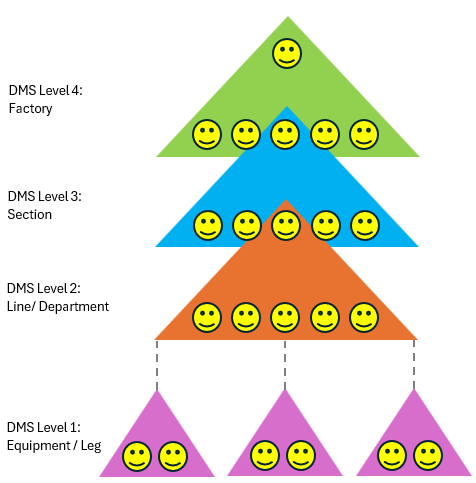
The Daily Management System is a fundamental system for building a highly efficient organization. It is a very simple yet powerful tool that engages employees at all levels to achieve goals. The short, regular meetings, which are the foundation of DMS, allow for effective tracking of current line performance and task completion. The interconnected meeting structure facilitates the implementation of the escalation and cascading process.

NEW: Gallery section support advanced layouts: Grid, Slider, Carousel, Masonry, Justified.









The brainstorming method is one of the most popular ways to solve problems. It involves generating ideas as a group, typically composed of individuals who are directly connected to the …
5W1H is a method that enables a deeper understanding of the problem at hand. Its name originates from the initials of the questions used to describe its methodology. Questions like …

As described in the previous article of Basics of DMS, DMS is based on short meetings that review the status of activities planned for the day, and performance indicators from …